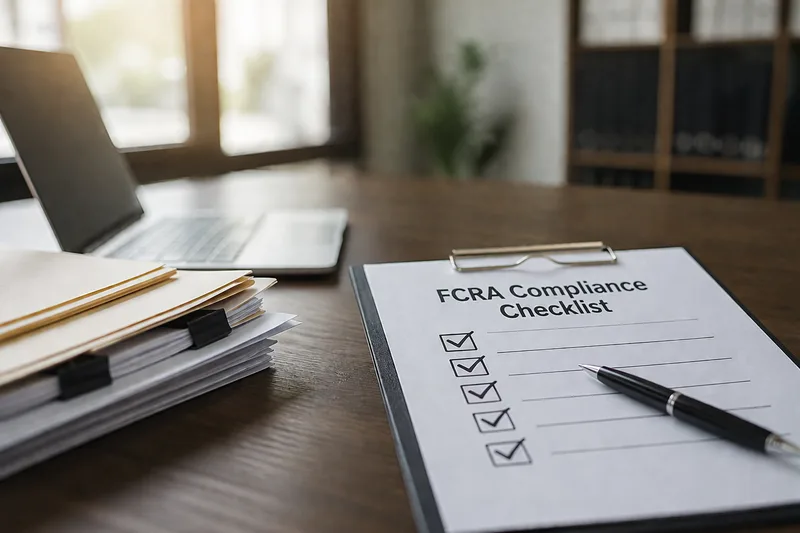
Pre-employment background screening is a regulated process governed by the Fair Credit Reporting Act (FCRA). It is a federal law that requires employers and their screening vendors to follow specific steps when collecting, verifying, and using candidate information. FCRA compliance helps reduce legal risk, protects candidate rights, and ensures hiring decisions are based on accurate data.
This compliance checklist for employers and HR teams covers the non-negotiable features every vendor must provide, explains what proper execution looks like, and shows you how to evaluate whether your background screening vendor meets FCRA requirements.
What is the FCRA, and why does it matter for employers?
The Fair Credit Reporting Act is a federal law enforced by the Federal Trade Commission (FTC) and the Consumer Financial Protection Bureau. It sets strict rules for how employers obtain and use background check reports, which are classified as consumer reports.
The FTC publishes clear guidance on employer responsibilities under the FCRA. You are legally responsible for how background checks are conducted, even when using a third-party vendor. Failure to comply can lead to lawsuits, class actions, financial penalties, and damage to your reputation. A reliable screening partner should help you meet these obligations, not leave gaps in your process.
FCRA Compliance Checklist for Background Checks
Use this checklist to evaluate whether your background screening provider is truly supporting compliance.
1. Clear Disclosure and Authorization Process
Before running a background check, employers must provide a standalone disclosure and obtain written consent from the candidate.
Your vendor should provide forms and compliant disclosure templates that are separate from other application materials and tailored to your jurisdiction. Some states and cities require additional notices. California, New York, and Washington have specific disclosure rules that go beyond federal requirements.
Ask your vendor whether their platform automatically generates the correct forms based on your company location and the candidate's jurisdiction. If they expect you to source your own forms or use a generic template, that is a compliance gap that exposes you to legal challenge.
2. Built-In Adverse Action Workflows
When a background check result leads to a decision not to hire, the FCRA mandates a two-step adverse action process.
First, you must send a pre-adverse action notice with a copy of the report and a summary of the candidate's rights under the FCRA. Then you must wait a reasonable period before sending the final adverse action notice.
Your vendor should automate this workflow. Look for a platform that generates pre-adverse and adverse action letters, tracks delivery, and documents the timeline. The EEOC provides guidance on how background checks should factor into hiring decisions, and your vendor's process should align with both EEOC and FTC standards.
3. Dispute Handling and Reinvestigation Support
Candidates have the right to dispute incomplete or inaccurate information in their consumer reports. When a dispute is filed, the vendor must investigate and respond within 30 days.
Your vendor should offer a structured dispute process with clear timelines and documentation. Look for a platform that logs every dispute, tracks the reinvestigation status, and stores the final resolution. Without this paper trail, you have no defense if a candidate claims their rights were violated.
4. Accurate and Verified Data Sources
The FCRA requires that screening information be accurate and up to date, which is why following a compliance checklist for background checks is essential. A vendor that relies solely on outdated or incomplete national databases without verifying records at the source is putting your organization at risk.
Ask your vendor how they confirm records. Do they pull directly from county courthouses? Do they verify employment and education claims through primary sources?
5. Secure Data Handling and Privacy Protection
The FCRA requires consumer report data to be stored securely, accessed only by authorized users, and disposed of properly. But not every vendor treats this with the same rigor.
Ask about encryption standards, access controls, retention schedules, and whether data is ever sent offshore for processing. This is especially important for maintaining candidate trust and meeting broader privacy expectations.
6. Audit Trails and Documentation
In the event of an audit or legal challenge, documentation is essential.
Regulators and plaintiffs' attorneys both love a clean paper trail. If you cannot prove that you followed the FCRA to the letter, you are vulnerable.
Your vendor should maintain detailed audit trails for every background check. This includes timestamps for when disclosures were sent, when authorizations were signed, when adverse action notices were delivered, and when disputes were resolved. Automated documentation beats manual record-keeping every time.
7. Ongoing Compliance Updates
Regulations change frequently at the federal, state, and local levels, making a compliance checklist for employers an important safeguard. A vendor that built its compliance engine three years ago and has not updated it since is a liability, not a partner.
Your vendor should monitor regulatory changes, adjust workflows and templates accordingly, and notify you of changes that impact hiring practices. Ask how often their disclosure library is updated and whether new ban-the-box laws or pay transparency requirements are reflected in their workflows without you having to ask.
8. Integration with Your Hiring Workflow
Compliance breaks down when background checks live in a separate system from your ATS or HRIS. Manual data entry creates delays, and delays create compliance gaps.
Your vendor should integrate directly with your applicant tracking system so that disclosure, authorization, and adverse action steps happen seamlessly inside your existing hiring workflow. Look for pre-built integrations or a browser extension that works with any system.
Compliance is easier when it is built into your process.
Choose a Screening Partner That Puts Compliance First
FCRA compliance is a shared responsibility, but your background screening vendor plays a critical role in helping you get it right. From disclosures and authorizations to adverse action workflows, every step should be handled with accuracy, transparency, and documentation.
That is why choosing the right partner matters. A strong screening provider should build compliance into the process, provide support when questions arise, and help reduce risk for both employers and candidates.
At 3rd Degree Screening, we make background checks easier to manage with a process designed around accuracy, efficiency, and compliance support.
Contact us today to learn how our background screening solutions can support safer, smarter, and more compliant hiring decisions.