“It is not enough to hear statewide. Ask which type.”
When an employer hears that a background check includes a “statewide criminal search,” it sounds straightforward. Search the state and get the state’s criminal records. In practice, the label can describe several very different products with different sources, coverage, costs, and limitations.
From a buyer’s perspective, that distinction matters. Two screening packages can both say they include a statewide search while doing completely different things behind the scenes.
Statewide Is Not One Thing
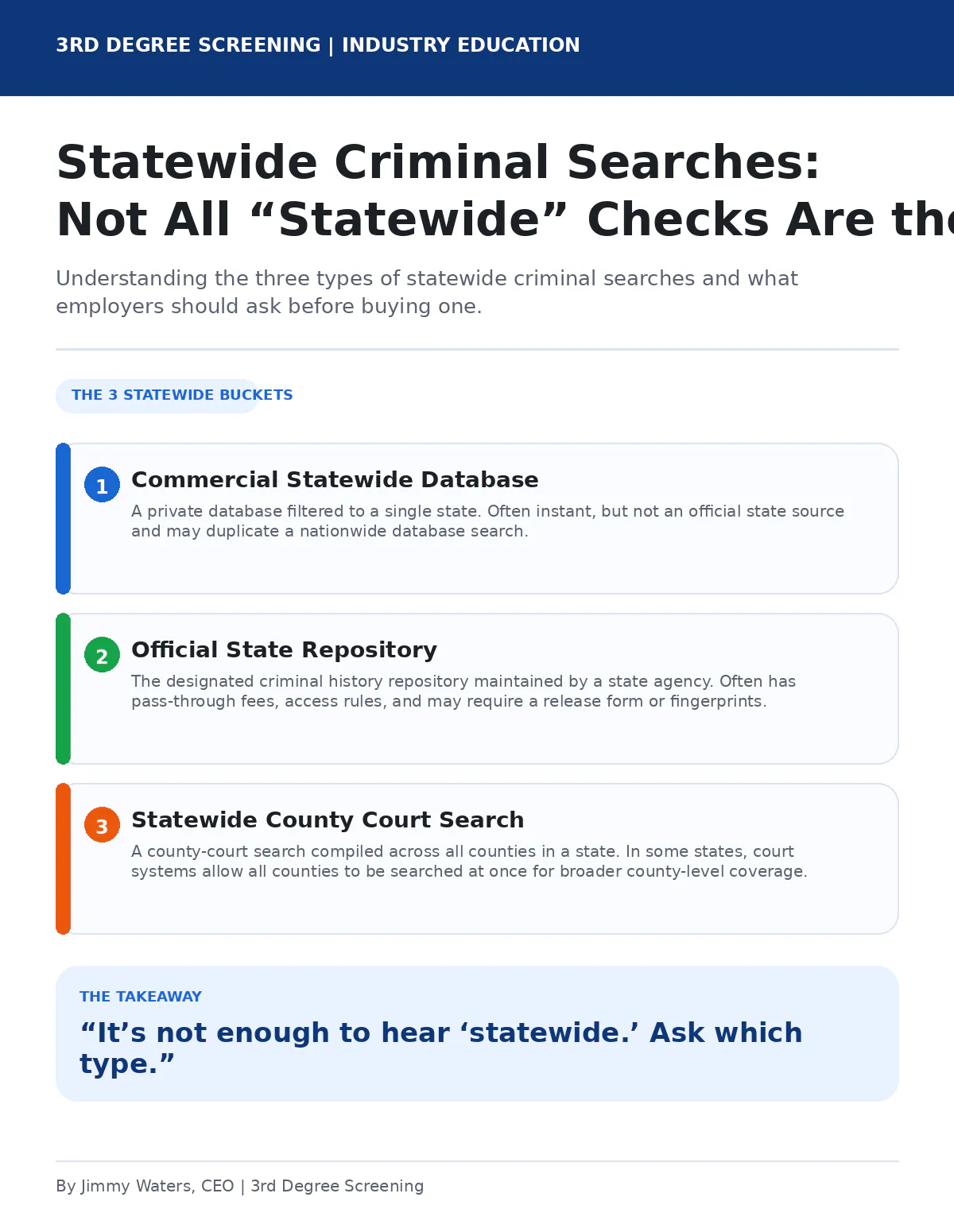
In our view, statewide criminal searches generally fall into three practical buckets: a commercial criminal database filtered to one state, an official state criminal-history repository search, or a statewide county-court search.
1. Commercial Statewide Criminal Database
The first bucket is often an instant database product. The provider filters commercial criminal record data to a particular state and markets the result as a statewide criminal database search.
This may be useful as a discovery tool, but employers should understand the source. It is not the same thing as querying the state’s official criminal-history repository or searching every county court in that state. If a nationwide criminal database is already part of the package, the statewide database may substantially overlap with data that has already been searched.
The right question is not whether the product says statewide. The right question is whether it adds a new source of information or simply repackages a subset of an existing commercial database.
2. Official State Criminal-History Repository
The second bucket is very different. Many states maintain an official central criminal-history repository through an agency such as a state police department, bureau of investigation, department of public safety, attorney general, or other designated agency.
These searches can carry state-imposed pass-through fees, requester restrictions, consent requirements, special forms, and different turnaround times. Some states offer name-based access. Others require fingerprints or limit who can request official criminal-history information.
Because these are official state sources, they can add meaningful coverage. But even an official repository should not automatically be assumed to contain every local court record in exactly the same way a direct county-court search would. Coverage, reporting rules, and record flow vary by state.
3. Statewide County-Court Search
The third bucket is a statewide county-court search. In states where court technology permits it, a provider may be able to search criminal court records across all counties through a centralized court system rather than ordering each county separately.
Conceptually, this is different from a central state criminal-history repository. The information is coming from court records rather than a state criminal-history agency. Iowa is an example of a state where court access can provide statewide county-level coverage across all 99 counties.
Which Type Is Better?
There is no universal answer. The best search depends on the state, the role, the employer’s risk model, legal requirements, and what other components are already included in the screening package.
An official repository may add unique statewide information. A statewide county-court search may provide broad court-level coverage. A commercial statewide database may be valuable as a discovery tool. The mistake is assuming all three products are equivalent because they share the word statewide.
A Practical Comparison
Commercial statewide database. Private aggregated data filtered to one state. Useful for broad discovery, but it may overlap with a nationwide database and is not an official state source.
Official state repository. Information from the state agency designated to maintain criminal history records. It can add official statewide coverage, but access rules, fees, fingerprint requirements, and completeness vary by state.
Statewide county-court search. Court-level searching across counties through a centralized state court system where available. This can provide broad county coverage, but availability and search architecture vary by state.
How Buyers Can Tell What They Are Getting
- What is the actual source of the search: a commercial database, an official state repository, or a court system?
- If it is an official repository, which state agency provides the information?
- Does the state charge a pass-through fee, and is that fee included or billed separately?
- Is the search name-based, fingerprint-based, or dependent on requester eligibility?
- Does the state require a special authorization or release form?
- If a national criminal database is already included, does this statewide product add a new source or mostly duplicate the same commercial data?
- Are federal criminal records searched separately? A statewide search does not replace federal district-court research.
Why Fees Can Be a Clue
Official state repositories often charge their own access or processing fee. That fee can be one clue that the search is coming directly from an official state source rather than from a privately aggregated database.
But fee alone is not proof. The strongest practice is to ask the screening provider to identify the source agency or court system used for the search, explain the coverage, and disclose any pass-through fee.
Resource: Official State Repository Reference
3rd Degree Screening maintains a working reference of designated state criminal-history repositories, public name-based availability, and typical agency fees. Because state access rules, fees, forms, and eligibility requirements can change, buyers should verify current requirements before relying on any static fee table.
The Bottom Line
For employers, the goal should not be to collect the largest number of products on an order. It should be to understand what each search contributes to the screening program and whether multiple products are actually adding unique coverage.
“A label tells you very little about coverage. Ask where the data comes from.”
About the Author
Jimmy Waters is CEO of 3rd Degree Screening, a consumer reporting agency providing employment background screening and related services to organizations across the United States. He works with employers on screening strategy, criminal-record research, compliance, adjudication, and risk management. Learn more at jimmywaters.com.
Sources and Reference Notes
- 3rd Degree Screening, State Criminal-History Repository Reference (companion working guide).
- Official state criminal-history repository agency websites and published access instructions.
- Official state judiciary and court-access systems where statewide county-court searching is available.
Repository access, fees, forms, fingerprint requirements, and requester eligibility can change. Verify current official agency requirements before publication or operational reliance.
Educational content only. Not legal advice. Requirements vary by jurisdiction and use case.